
This post first appeared on September 28, 2022 at AEIdeas. AEIdeas is a public policy blog from the American Enterprise Institute (AEI).
In a previous post, we explained how President Joe Biden’s student loan forgiveness plan could result in $4.8 billion in additional state income taxes from borrowers in seven states. Indiana, Minnesota, Mississippi, and North Carolina have already announced plans to tax debt forgiveness, while borrowers in Arkansas, California, and Wisconsin await the state’s determination. Several media outlets have calculated borrowers’ maximum possible state tax increases, but little is known about the distribution of these tax bills.
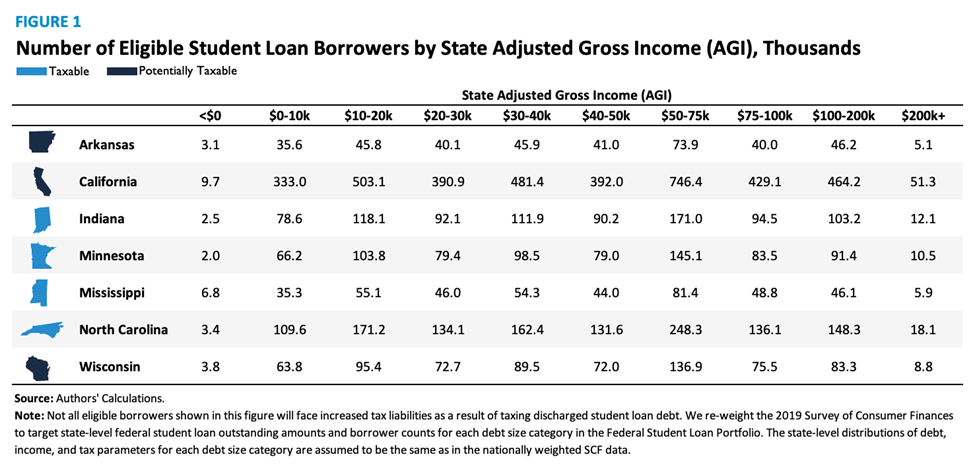
Using data from the Department of Education’s Federal Student Loan Portfolio and the 2019 Survey of Consumer Finances, we estimate that 8.2 million borrowers across these seven states are eligible for debt forgiveness (97 percent of the total borrower population). Figure 1 presents the number of eligible student loan borrowers by state adjusted gross income (AGI) level. Eighty-six percent of eligible borrowers in each state have AGI less than $100,000, and over half have AGI less than $50,000.
The state tax liability for any particular borrower depends not only on the amount of debt forgiven but also on income, filing status, and Pell Grant recipient status. Figure 2 shows estimated state tax increases for a hypothetical married joint filer with $10,000 in outstanding student loan debt. These estimates are the simple difference between state income tax with and without income from loan forgiveness for an individual borrower. For this calculation, we use each state’s 2022 income tax bracket and rate schedules and do not consider the effects of changes in state credits or other tax provisions. For eligibility cut-offs by taxable income, we subtract state standard deductions by filing status and any exemptions (one for single filers, two for married joint filers, and no dependents).
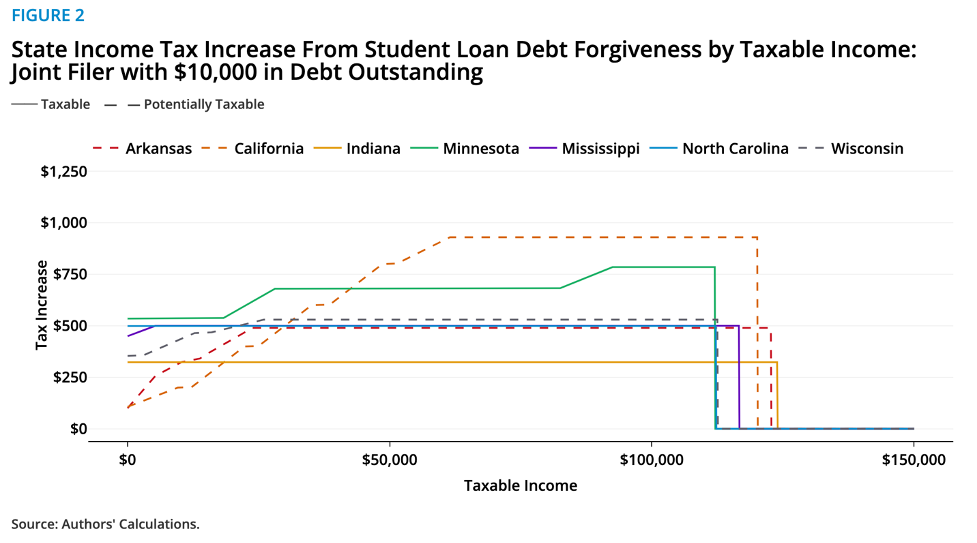
Figure 3 presents summary data on average increases in state income tax by AGI based on the distributions of income, debt, and relevant tax parameters from the Survey of Consumer Finances. Given limitations in available data on the number and distribution of borrowers with Pell Grants, average state tax increases for forgiveness up to $10,000 and up to $20,000 are presented, with the lower value assuming no Pell Grant benefits and the higher value assuming all borrowers are Pell Grant recipients. These estimates also consider state tax increases resulting from changes in select state credit eligibilities.
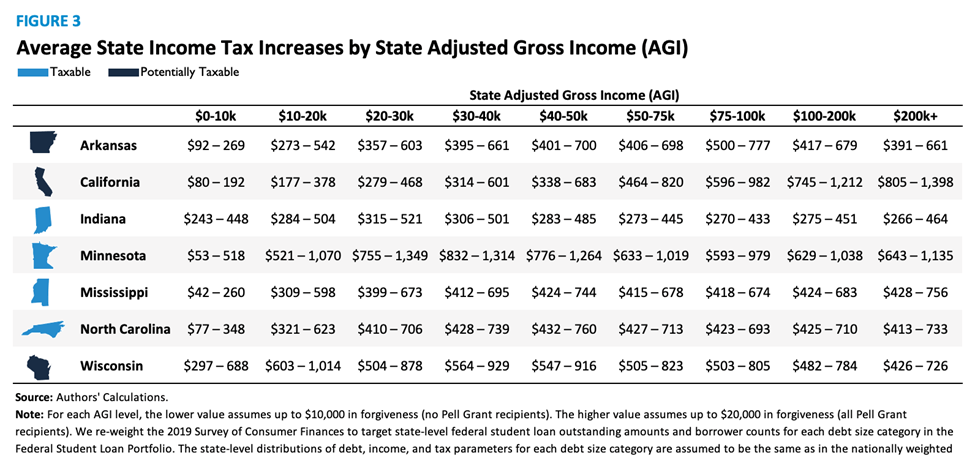
On average, borrowers in Wisconsin with adjusted gross incomes less than $20,000 will see a larger tax increase than similar borrowers in other states. Borrowers in Minnesota could face the largest tax increases on average, but high earners in California could pay the largest tax hikes overall.
Although this analysis presents a detailed view of potential state tax liabilities under plausible assumptions, it should not be construed as tax advice. States may issue additional guidance on taxing student loan forgiveness in coming months and may even pass new tax laws affecting these calculations. Arkansas, California, and Wisconsin have yet to make final decisions. Other complications, such as IRS instructions not to furnish cancellation of debt Form 1099-Cs to taxpayers or the IRS itself, could make it administratively difficult for states to tax this income. The final list of states deciding to tax student loan forgiveness and actual taxpayer liabilities may be smaller than presented.
Note: This post was updated on January 25, 2023. Figure 2 now shows estimated state tax increases for a hypothetical married joint filer with $10,000 in outstanding student loan debt. An earlier version calculated estimated state tax increases for reader-supplied inputs.
Citation
@misc{brill2022,
  author = {Brill, Alex and Seiter, Grant M.},
  publisher = {American Enterprise Institute},
  title = {President {Biden’s} {Student} {Loan} {Forgiveness:} {The}
    {Impact} on {Individuals’} {State} {Taxes}},
  date = {2022-09-28},
  url = {https://www.aei.org/economics/president-bidens-student-loan-forgiveness-the-impact-on-individuals-state-taxes/},
  langid = {en}
}