
This post first appeared on September 28, 2021 at AEIdeas. AEIdeas is a public policy blog from the American Enterprise Institute (AEI).
The Biden administration and Democratic lawmakers in Congress are now considering proposals to raise the tax burden on corporations in the United States. In a new AEI report, which will be released in full next month, one of us (Pomerleau) compares the US corporate tax burden under current law, the Biden administration’s proposal, and the House Ways and Means proposal to corporate tax codes in 36 OECD nations. Here, we offer a preview of the findings and introduce a web application that allows users to explore more of the data and analysis.
Click here to open the interactive web application.
The report compares corporate tax burdens using three measures:
The statutory corporate income tax rate is the rate at which each dollar of corporate taxable income is taxed. Alone, it does not fully capture the total tax burden on corporations, but it does reflect the attractiveness of locating profits in a jurisdiction.
The marginal effective corporate tax rate (METR) measures the tax burden on marginal investment for an investment that breaks even in present value. The METR incorporates deductions, credits, and special lower tax rates afforded to corporations. It measures the impact a corporate tax has on the level of investment in a jurisdiction.
The average effective corporate tax rate (AETR) measures the tax burden on new investments that earn above-normal returns or economic rents. Like the METR, the AETR incorporates deductions, credits, and special lower rates. This rate, however, measures the impact a corporate tax has on the incentive to locate investment in a jurisdiction.
Under current law, the United States statutory corporate tax rate of 25.8 percent (21 percent federal statutory rate plus the average of state and local corporate tax rates) is slightly below the OECD average (weighted by GDP) of 26 percent. The METR on corporate investment in the United States, under current law, is 18.3 percent, 2.8 percentage points higher than the OECD average. The AETR in the United States is 23.4 percent, which is roughly in line with the OECD average of 22.9 percent.
The Biden administration has proposed raising the statutory corporate income tax rate to 28 percent, while the House Ways and Means Committee has approved a proposal to raise the corporate tax rate to 26.5 percent. Lawmakers have also proposed reforming the tax treatment of foreign profits of US multinational corporations and repealing or reforming the low tax rate on foreign-derived intangible income (FDII). Their goals are to increase federal revenue, increase the tax burden on capital income, and reduce profit shifting by US multinational corporations.
The Biden and House proposals would raise the statutory and effective tax rates to nearly the highest in the OECD (see the table below). Both proposals increase the tax burden on domestic corporate investment, reduce the incentive to invest in the United States, and increase the incentive to shift profits and high-return assets into low-tax jurisdictions.
The web application provides additional context, such as how effective tax rates vary by type of asset within OECD countries and how corporate tax codes treat debt and equity-financed investment. The application also allows users to explore how the effective tax burden on investment in the United States would differ if lawmakers permanently extended temporary provisions, such as bonus depreciation and research and development expensing, which are scheduled to phase out over the next decade.
Click here to open the interactive web application.
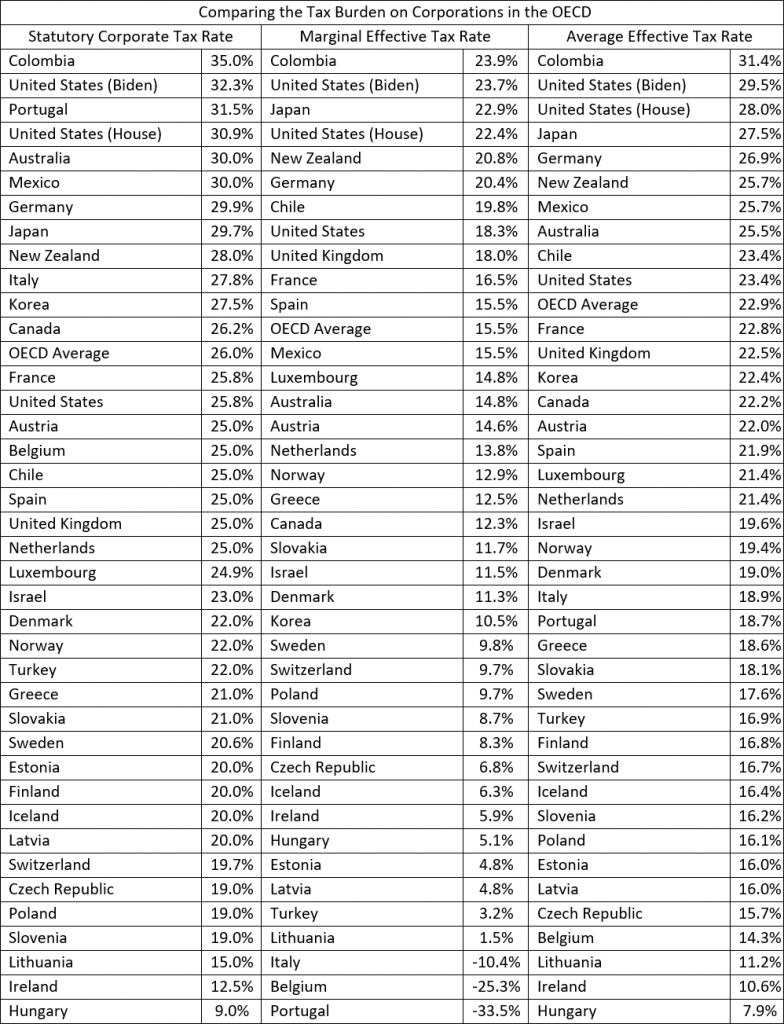
Update: On September 14, 2021, Colombia raised its corporate tax rate to 35 percent effective January 2022. The estimates in this post and accompanying web application have been updated to reflect this recently passed reform.
Citation
@misc{pomerleau2021,
  author = {Pomerleau, Kyle and Seiter, Grant M.},
  publisher = {American Enterprise Institute},
  title = {How {Would} the {US} {Corporate} {Tax} {Burden} {Compare}
    with {Those} of {Other} {Developed} {Nations?}},
  date = {2021-09-28},
  url = {https://www.aei.org/economics/how-would-the-us-corporate-tax-burden-compare-with-those-of-other-developed-nations/},
  langid = {en}
}